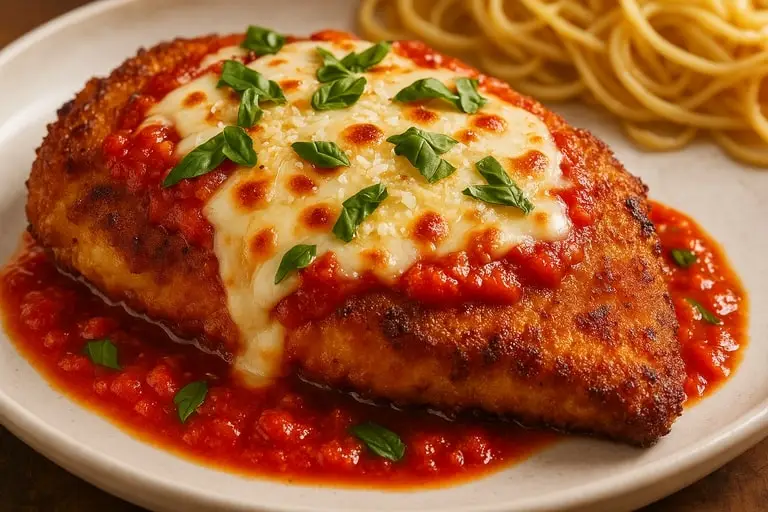
The chicken Parmesan recipe has become one of the most iconic Italian-American dishes, blending tender breaded chicken cutlets with marinara sauce, melted mozzarella, and Parmesan cheese into a meal that feels both indulgent and comforting. Known in Italy as “parmigiana,” the dish evolved after Italian immigrants brought culinary traditions to the United States in the late nineteenth and early twentieth centuries. While rooted in Southern Italian eggplant parmigiana, the adaptation to chicken reflects both cultural blending and practical adjustment to available ingredients. Today, chicken Parmesan represents not only a beloved comfort food but also a symbol of Italian-American culinary creativity.
At its core, the dish exemplifies the philosophy of layering. Breaded chicken offers crisp texture, marinara provides acidity and depth, and melted cheese delivers richness. The interplay of these elements creates balance, where no single component dominates. This layered structure reflects Italian culinary traditions, emphasizing harmony through simplicity, while the portion sizes and abundance typical of American dining influenced its modern form.
The preparation of chicken Parmesan highlights culinary transformation. Chicken breasts are pounded thin for even cooking, breaded in flour, egg wash, and breadcrumbs, then fried until golden. The act of frying creates crisp exterior that contrasts with tender interior, setting stage for layering. Once topped with marinara and cheese, the cutlets are baked, where heat melts cheese and integrates flavors. This transformation illustrates how ordinary ingredients become extraordinary through technique.
Culturally, chicken Parmesan embodies dual heritage. In Italy, parmigiana dishes emphasize vegetables, particularly eggplant. In America, chicken reflected availability and preference, creating a dish that resonated with immigrant communities while appealing to broader audiences. Italian-American restaurants embraced chicken Parmesan as centerpiece of menus, where it symbolized both authenticity and adaptation. Over time, it became standard in red-sauce establishments and households alike, affirming its place as culinary bridge between cultures.
Flavor balance distinguishes successful versions. Marinara sauce, with its acidity and herbs, cuts richness of fried chicken and cheese. Parmesan adds sharpness, while mozzarella offers creaminess and meltability. Herbs like basil and oregano infuse aroma, ensuring complexity without excess. The interplay of these flavors confirms why chicken Parmesan endures: it satisfies multiple cravings simultaneously.
The sensory experience enhances its popularity. The sound of cutlets sizzling in oil, the sight of bubbling cheese over red sauce, and the aroma of garlic, tomato, and basil combine to create anticipation. The first bite delivers crunch, tang, and creaminess, engaging multiple senses at once. These sensory qualities ensure chicken Parmesan resonates not just as food but as ritual and memory.
From a nutritional perspective, chicken Parmesan leans indulgent but allows for adaptation. Baking instead of frying reduces fat, while lighter cheeses or fresh herbs enhance flavor without heaviness. Adding side salads or vegetables balances richness, aligning dish with modern health-conscious values. Its adaptability ensures continued relevance while retaining identity.
Professional kitchens elevate chicken Parmesan through refinement. Chefs may use artisanal cheeses, house-made sauces, or panko for extra crispness, presenting dish elegantly while honoring roots. Even fine dining establishments occasionally reinterpret chicken Parmesan, proving that comfort food can achieve sophistication without losing essence.
Global adaptations further confirm its universality. Variations appear in Australia, where “parma” is pub staple, or in fusion cuisines that incorporate diverse cheeses and spices. Each iteration reflects cultural exchange while preserving the core identity: breaded chicken layered with tomato and cheese. This adaptability ensures chicken Parmesan’s enduring role as international comfort.
Ultimately, the chicken Parmesan recipe embodies tradition, adaptation, and comfort. Rooted in Italy yet thriving in America, it demonstrates how food evolves through migration and memory. More than a dish, it symbolizes heritage, transformation, and the joy of shared meals, ensuring its timeless place in kitchens worldwide.
Chicken Parmigiana and Recipe Mastery
Perfecting chicken parmigiana, or chicken Parmesan, requires attentiveness to detail at every stage, where texture, balance, and flavor converge. While recipes appear straightforward, true mastery lies in subtleties that elevate the dish from ordinary to extraordinary.
Ingredient selection forms foundation of mastery. Chicken breasts, chosen for size and tenderness, must be trimmed and pounded evenly to ensure consistent cooking. Quality marinara, whether homemade or carefully sourced, defines flavor balance, while mozzarella and Parmesan must be fresh to guarantee melt and sharpness. Bread quality for crumbs also influences crispness, reflecting how even minor ingredients shape outcomes.
Preparation begins with breading process. Flour provides dry base, egg wash creates binding, and breadcrumbs form crisp shell. Mastery involves seasoning each layer, ensuring flavor permeates exterior rather than relying solely on sauce. Frying develops golden crust, but oil temperature must be precise: too low yields greasiness, too high risks burning. This attentiveness distinguishes mastery from mediocrity.
Marinara sauce functions as second pillar. Its acidity balances richness, while herbs contribute complexity. Fresh garlic sautéed in olive oil, tomatoes simmered to concentration, and basil added near the end ensure vibrancy. A weak sauce compromises dish entirely, underscoring its critical role in balance.
Cheese layering defines indulgence. Mozzarella provides stretch and creaminess, while Parmesan sharpens and enhances umami. Blending both creates balance, with proportion ensuring richness without overwhelming. Mastery involves calibrating cheese to complement rather than smother, affirming that restraint enhances rather than diminishes.
Baking represents moment of integration. The transition from stovetop to oven allows cheese to melt, flavors to blend, and cutlets to remain crisp beneath sauce. Mastery requires timing: too long softens crust excessively, too short prevents cohesion. The ideal bake unites elements seamlessly.
Presentation elevates dish further. Garnishing with basil leaves, serving alongside al dente pasta, or pairing with fresh salad demonstrates care. Visual appeal matters as much as flavor, reinforcing that mastery includes aesthetics. A well-presented plate transforms chicken Parmesan into experience rather than mere meal.
Adaptations demonstrate flexibility. Health-conscious cooks may bake cutlets instead of frying, while gourmets may use artisanal cheeses or heirloom tomatoes. Plant-based versions replicate flavors with alternative proteins and dairy substitutes. These variations prove that mastery respects tradition while embracing inclusivity.
Professional kitchens refine chicken Parmesan further. Chefs may adjust thickness of cutlets, incorporate panko for enhanced crunch, or reduce sauce for intensity. These touches, while subtle, elevate dish into signature, proving mastery arises from details.
Psychologically, recipe mastery embodies care. Preparing chicken Parmesan from scratch signals intention and investment, transforming cooking into ritual of generosity. Sharing it at tables affirms bonds, reinforcing dish as act of comfort and love.
Ultimately, chicken parmigiana mastery reflects harmony between crispness, acidity, richness, and presentation. By respecting tradition, adjusting details, and embracing balance, cooks elevate chicken Parmesan into both culinary heritage and personal signature.
Chicken Parmesan Recipe and Everyday Comfort
The chicken Parmesan recipe resonates deeply as comfort food, uniting nostalgia, flavor, and ritual. Beyond its technical merits, it sustains cultural and emotional needs, offering reassurance and continuity through every bite. Its popularity across households and restaurants reflects its power to comfort through both tradition and adaptability.
The aroma of frying cutlets, simmering marinara, and melting cheese creates anticipation that comforts before tasting. These sensory cues, familiar across kitchens, ground individuals in ritual, reinforcing continuity between generations. For many, chicken Parmesan evokes family gatherings or restaurant outings, embedding comfort in memory as much as in flavor.
In households, chicken Parmesan often symbolizes celebration. Served at Sunday dinners, holidays, or special occasions, it embodies abundance and care. Its preparation requires effort, signaling investment in those who will share it. This symbolism ensures dish functions as more than sustenance, reinforcing bonds through generosity.
Culturally, chicken Parmesan reflects immigrant resilience. Italian-American families adapted traditions to new lands, creating dish that honored heritage while embracing adaptation. Its enduring presence affirms identity, proving comfort food often arises from blending memory with innovation.
The sensory qualities amplify comfort further. Crunchy cutlets beneath tangy sauce and creamy cheese deliver contrasts that soothe while exciting palate. Eating chicken Parmesan evokes security through familiarity while satisfying desire for richness. Comfort arises from both predictability and indulgence.
Psychologically, chicken Parmesan provides reassurance. Its consistency across contexts—from home kitchens to restaurants—anchors individuals during uncertainty. Knowing what to expect delivers stability, proving that comfort resides in familiarity as much as in novelty.
Modern lifestyles enhance its relevance. Simplified versions in casseroles or sandwiches adapt dish to busy schedules, ensuring its essence remains accessible. Even frozen or restaurant options affirm its popularity, though homemade versions retain unmatched resonance.
Nutritionally, chicken Parmesan balances indulgence with adaptability. By moderating portion sizes, using leaner chicken, or pairing with fresh sides, households align dish with health goals without diminishing comfort. This adaptability sustains relevance across diverse lifestyles.
Professional kitchens elevate comfort through refinement, but essence persists. Whether plated elegantly or served family-style, chicken Parmesan retains identity as food that unites, comforts, and reassures. Its adaptability across contexts underscores universality.
Ultimately, the chicken Parmesan recipe embodies everyday comfort by blending tradition, indulgence, and memory. Its flavors soothe, its rituals reassure, and its cultural role affirms continuity. In every layer of crisp cutlet, tangy sauce, and melted cheese lies a story of resilience, generosity, and comfort that sustains across generations and cultures.
Few dishes embody the fusion of tradition and comfort as gracefully as chicken parmesan, a recipe that combines Italian roots with American adaptation to create a global favorite. Known for its golden breaded cutlets, tangy tomato sauce, and bubbling layer of melted cheese, it represents both indulgence and familiarity. A chicken parmesan recipe is more than just a set of steps — it is an invitation to create warmth at the table, blending crisp textures, rich flavors, and the universal appeal of comfort food. Its enduring popularity lies in its ability to balance elegance with accessibility, satisfying both family dinners and restaurant menus alike.
The origins of chicken parmesan trace back to Italian immigrants who settled in the United States in the early twentieth century. Inspired by traditional eggplant parmigiana from Southern Italy, cooks adapted the dish by substituting chicken, which was more affordable and readily available in their new homeland. Over time, the adaptation became iconic in Italian-American cuisine, embraced in both casual diners and upscale restaurants. What began as a humble reinterpretation has since become a signature dish across the globe, recognized instantly for its combination of crispy chicken, tomato sauce, and melted cheese.
At the core of every chicken parmesan recipe is the cutlet itself. Boneless chicken breasts are pounded thin to ensure even cooking and a tender bite. Each piece is coated in flour, dipped in egg, and dredged in breadcrumbs, often seasoned with herbs and parmesan cheese for extra flavor. The cutlets are then pan-fried until golden, their exterior crisp while the inside remains juicy. This step is essential, as it provides the textural foundation of the dish: a crunch that contrasts beautifully with the softness of sauce and cheese added later. It is in this stage that the transformation begins, turning simple chicken into something extraordinary.
The sauce is the soul of chicken parmesan. A rich tomato base infused with garlic, onions, olive oil, and herbs like basil and oregano creates the heart of the dish. Depending on preference, the sauce may be chunky and rustic or smooth and velvety, but its role is always the same: to provide balance. The acidity of tomatoes cuts through the richness of fried chicken and melted cheese, creating harmony in each bite. A well-made sauce elevates the dish from ordinary to exceptional, proving that attention to detail is what defines mastery in cooking.
Cheese is the crowning glory of chicken parmesan, lending indulgence and visual appeal. Mozzarella provides gooey melt, parmesan offers sharpness and depth, and sometimes provolone adds an extra layer of richness. Sprinkled generously over the sauced cutlets, the cheese is broiled or baked until bubbling and golden. This step transforms the dish into a sensory experience, where the sight of molten cheese, the aroma of roasted dairy, and the first pull of a gooey bite create immediate satisfaction. Cheese is not just garnish but the final element that completes the balance of textures and flavors.
Culturally, chicken parmesan has become more than just food; it is a symbol of Italian-American identity and hospitality. It often appears at family gatherings, holidays, and celebrations, where its abundance and richness communicate generosity. In restaurants, it has become a benchmark dish, one that diners order for familiarity and comfort. Beyond its Italian-American roots, it has been embraced in countless countries, proving its universality. To serve chicken parmesan is to serve not just nourishment but also tradition, memory, and a sense of belonging.
The sensory qualities of chicken parmesan explain its lasting appeal. The crunch of breaded chicken, the tang of tomato sauce, the richness of melted cheese, and the herbal freshness of basil combine into a symphony of contrasts. The aroma of garlic and tomatoes fills the kitchen as it bakes, building anticipation. The golden, bubbling cheese atop red sauce creates a visual feast before the first bite. Eating it engages every sense, ensuring that the experience is as emotional as it is physical. These qualities elevate the dish from mere recipe to culinary icon.
Nutritionally, chicken parmesan offers both indulgence and adaptability. While the traditional preparation is rich, adjustments can create lighter versions without sacrificing flavor. Baking instead of frying cutlets, using part-skim cheese, or serving with extra vegetables instead of pasta are common adaptations. The recipe is flexible enough to meet modern dietary goals while retaining its essence. At its heart, chicken parmesan is about balance — richness offset by acidity, indulgence moderated by adaptability — making it a dish that can satisfy diverse lifestyles.
Economically, chicken parmesan demonstrates practicality. It relies on affordable ingredients — chicken, tomatoes, breadcrumbs, and cheese — yet delivers a meal that feels luxurious. It can be prepared in large quantities, making it ideal for family dinners, gatherings, or restaurant service. Leftovers are equally appealing, whether reheated as a complete dish, tucked into sandwiches, or served atop salads. This practicality underscores why the recipe has endured: it stretches resources while delivering indulgence, offering both abundance and value.
Modern interpretations of chicken parmesan reveal its adaptability. Some chefs experiment with global influences, incorporating spicy chilies, exotic cheeses, or fusion sauces. Others reinterpret the dish in minimalist ways, highlighting artisanal tomatoes or heritage chicken breeds. Vegan versions replicate the experience with plant-based proteins and dairy alternatives, proving that the essence of chicken parmesan transcends ingredients. These innovations demonstrate the resilience of the recipe, capable of evolving with cultural shifts while staying rooted in tradition.
Psychologically, chicken parmesan carries deep associations with comfort and care. Preparing it requires effort — pounding, breading, frying, layering, and baking — and that effort communicates love. Sharing it with family or friends magnifies the meaning, transforming dinner into an expression of connection. The anticipation of lifting a bubbling dish from the oven, the ritual of serving it hot, and the satisfaction of seeing it enjoyed reinforce its place in memory. It is food that comforts in solitude, yet also strengthens bonds in company, embodying the emotional resonance of tradition.
Ultimately, the chicken parmesan recipe endures because it embodies what food at its best should be: nourishing, comforting, and celebratory. It transforms simple ingredients into a dish that feels abundant and festive, balancing richness with freshness, indulgence with accessibility. It connects cultures, generations, and households, proving that true culinary icons arise from both tradition and adaptability. In every bite lies not just flavor but history, memory, and meaning — a reminder that food is never only about eating but about the stories, emotions, and connections it carries.