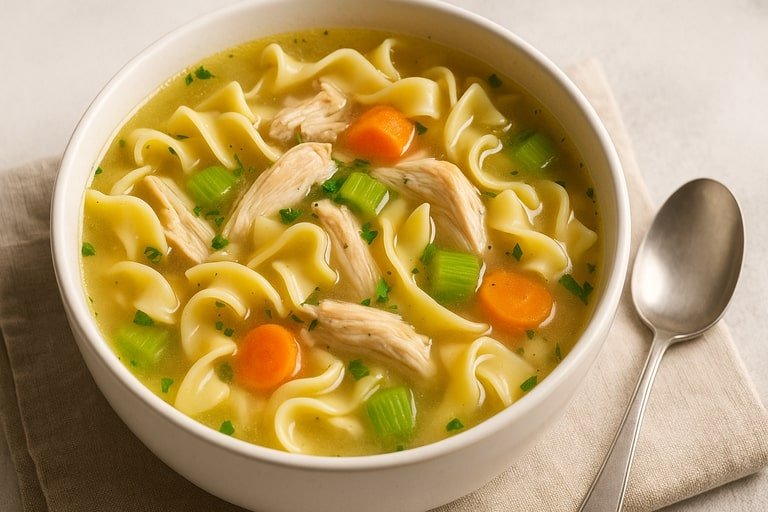
Chicken noodle soup carries a cultural weight far beyond its ingredients, standing as a symbol of nourishment, healing, and home across generations. To create a version that satisfies both tradition and modern taste, the cook must focus on balance. At its base, the broth serves as the soul of the soup. Simmering a whole bird or a collection of bones with onion, carrot, and celery for hours releases layers of flavor and nutrition, yielding a golden liquid that forms the foundation for every spoonful. This stage cannot be rushed; the patience required transforms simple water into a restorative essence.
When the broth has developed clarity and depth, the choice of chicken becomes essential. Using bone-in pieces adds richness, while shredded breast or thigh meat contributes texture. Timing matters; overcooking dries the meat, undercooking leaves it tough. Removing the chicken at the right moment and returning it once the noodles are nearly tender ensures that each bite is moist and flavorful. The addition of vegetables lends contrast, both in color and taste. Carrots bring sweetness, celery delivers freshness, and onions tie the flavors together. Some cooks add parsnip or leek, expanding the profile, but restraint is important—too many vegetables can overwhelm the broth.
Noodles play an equally important role. Egg noodles remain the classic choice, their slightly chewy bite complementing the soft chicken and tender vegetables. However, noodle thickness matters; wide noodles absorb broth differently than thin ones, altering the soup’s final body. Cooking them directly in the broth adds starch that thickens the liquid slightly, but risks sogginess if not timed carefully. For many, cooking noodles separately and combining just before serving maintains integrity and avoids clouding the broth.
Seasoning elevates or diminishes the result. Salt must be applied gradually, layered throughout the cooking process rather than dumped in at the end. Freshly ground black pepper cuts through richness, and herbs like thyme, parsley, or dill can brighten the aroma. Bay leaves simmering alongside bones add subtle depth, while a squeeze of lemon at the end sharpens flavor. These small touches transform a basic recipe into something memorable.
Cultural interpretations reveal the dish’s adaptability. In the United States, thick noodles and hearty broth dominate, while in Eastern Europe, versions lean lighter and more aromatic. Asian traditions often substitute rice noodles or add ginger and garlic, turning the same foundation into something entirely new. These variations demonstrate that chicken noodle soup is less a fixed formula than a universal concept, adaptable to ingredients, culture, and circumstance.
For the home cook, preparation is as much ritual as recipe. Selecting ingredients, waiting for the slow simmer, tasting along the way—these steps provide mindfulness in a world accustomed to speed. The reward is not only the soup itself but also the calm derived from the process. This is why so many associate the dish with comfort: it represents care given through patience and intention.
The connection between food and wellness also explains its reputation as a restorative meal. Hot broth soothes sore throats, steam clears congestion, and the balance of protein, carbohydrate, and hydration supports recovery. Scientists suggest that the combination of vegetables and chicken produces anti-inflammatory effects, though for many, the healing power is as much psychological as physical. Being offered chicken noodle soup during illness communicates empathy and love, reinforcing its reputation as food for both body and soul.
Practical adjustments keep the dish relevant today. Busy households use slow cookers or pressure cookers to shorten the simmer without sacrificing depth. Health-conscious cooks reduce sodium or substitute whole-grain noodles, while others experiment with plant-based proteins yet retain the same restorative structure. Each adjustment reflects how the soup remains alive, continuously evolving yet firmly rooted in tradition.
Serving the soup deserves attention as well. A wide bowl allows broth, meat, and noodles to mingle, while a garnish of fresh herbs adds color and aroma. Pairing with crusty bread completes the meal, though the soup alone provides satisfaction. Leftovers often deepen in flavor overnight, making the second serving even more rewarding than the first.
Ultimately, chicken noodle soup persists because it fulfills multiple roles: sustenance, tradition, comfort, and ritual. Few recipes deliver so much with such humble ingredients. For the cook, mastery lies not in complexity but in care, attention, and respect for process. Each bowl tells a story of patience rewarded and generosity expressed, proving that the simplest dishes often hold the deepest meaning.
Chicken Soup and Noodle Soup Variations
Chicken noodle soup has close relatives in nearly every cuisine, each variation reflecting local ingredients and cultural values. When comparing chicken soup to other noodle soups, one quickly sees that technique and balance matter more than any rigid recipe. A well-prepared broth anchors every version, whether flavored with dill in Eastern Europe, miso in Japan, or chili and lime in Southeast Asia. The protein remains familiar—chicken in most cases—but the noodles change, taking on local forms that redefine the dish entirely. Rice noodles, wheat noodles, or handmade egg noodles each create different textures and experiences.
In Chinese cuisine, clear chicken soup with fine noodles emphasizes purity of flavor, often enhanced with ginger and scallion. The broth is lighter, less salty, and designed to refresh rather than overwhelm. Japanese ramen based on chicken stock layers soy, miso, or shio, creating umami-driven profiles with toppings like nori and egg. Vietnamese pho ga presents chicken with rice noodles, aromatic herbs, and lime, producing a balance of lightness and intensity that contrasts with the heartier Western versions. These global traditions reveal how a simple concept expands into an extraordinary range of flavors.
Closer to home, American chicken noodle soup distinguishes itself through richness. The broth simmers long and slow, developing density and concentration. The noodles are wide, the vegetables plentiful, and the chicken generous. It is less about refinement and more about hearty satisfaction, a bowl designed to restore energy during winter evenings or family gatherings. Unlike the precision of Asian versions, it tolerates flexibility, with home cooks improvising based on pantry availability. This adaptability is part of its charm and one reason it endures as a domestic staple.
Europe offers equally fascinating adaptations. In Poland, rosół forms the basis of countless meals, a clear broth poured over fine noodles or dumplings. Russia favors lapsha, combining chicken stock with handmade pasta for celebratory tables. In Greece, avgolemono transforms the broth with egg and lemon, creating a silky, tangy variation beloved for its bright character. Each reflects the idea that chicken soup is not merely sustenance but an expression of cultural identity.
The distinction between chicken soup and broader noodle soups also matters. While the former highlights poultry as its defining element, the latter encompasses countless combinations of broth, starch, and toppings. Yet when the two overlap—chicken and noodles together—the result satisfies a nearly universal craving for warmth and completeness. That overlap explains why chicken noodle soup has achieved such global resonance.
Nutritional qualities add another dimension. In all cultures, soups combining protein, carbohydrate, and vegetables provide balanced nourishment. Chicken delivers lean protein, noodles supply energy, and broth hydrates while carrying essential vitamins and minerals. Whether enriched with miso, spiced with chili, or thickened with egg, the underlying principle remains unchanged: this is food designed to comfort, restore, and sustain.
The techniques of preparation vary, but patience remains constant. A rushed broth lacks complexity, and overcooked noodles ruin texture. Experienced cooks know that attention to timing separates ordinary soup from memorable ones. In traditional households, the process becomes a ritual, passed down from elders to younger generations, reinforcing continuity while allowing space for innovation.
Modern kitchens embrace shortcuts, but even with convenience appliances, the philosophy persists. A pressure cooker may reduce hours to minutes, yet the intention remains to coax depth of flavor from bones, meat, and vegetables. Innovations such as gluten-free noodles or low-sodium bases allow more people to enjoy the dish without compromise. This adaptability ensures chicken noodle soup remains relevant despite shifting dietary needs.
Beyond its culinary function, the soup carries symbolic meaning. In many cultures, it is the dish offered during milestones: recovery from illness, mourning, or even celebration. Its presence reassures, signaling that care is being expressed in edible form. Food anthropologists argue that chicken noodle soup occupies a rare position as both everyday sustenance and ceremonial dish, bridging routine and ritual.
For the individual cook, mastery of chicken and noodle soups provides a foundation in culinary technique: stock-making, timing, seasoning, and balance. Once understood, these principles apply broadly, enriching other cooking projects. Thus, while the dish may seem humble, it is also an education, teaching lessons that extend far beyond the bowl itself.
Chicken Noodle Soup Easy Recipe for Comfort Food
When approaching chicken noodle soup as an easy recipe, the goal is not to sacrifice quality but to streamline steps without losing character. The challenge lies in preserving depth of flavor within the constraints of modern schedules. A carefully selected rotisserie chicken, for instance, provides both meat and bones for broth, cutting hours from preparation while still producing a base superior to packaged alternatives. Simmering the carcass with aromatics for even thirty minutes extracts enough richness to elevate the final dish beyond ordinary.
Once the broth is ready, assembly moves quickly. Shredded chicken joins simmering vegetables, and noodles cook until just tender. The trick to maintaining integrity lies in managing sequence: noodles enter last, herbs finish at the very end, and seasoning is adjusted gradually. These small details distinguish hurried soups from those that feel crafted with care. Even in abbreviated form, attention matters.
The psychological aspect of ease cannot be overlooked. For many home cooks, the idea of preparing soup from scratch feels daunting. Simplifying steps without diluting results empowers more people to make it themselves. This accessibility explains the popularity of quick chicken noodle soup recipes online, as they offer achievable pathways to comfort without requiring professional skills. Yet shortcuts must be chosen wisely. Using store-bought broth can work, but enhancing it with fresh herbs and a splash of lemon prevents flatness. Pre-cut vegetables save time but should be sautéed briefly to unlock aroma before entering the pot.
In practice, these adjustments produce bowls nearly indistinguishable from longer preparations, proving that ease does not equal compromise. The result still carries warmth, still restores energy, and still communicates care. The emphasis shifts from ritual to practicality, but the underlying essence remains intact. Families enjoy the same comfort in half the time, which in today’s pace often matters as much as tradition.
Interestingly, the notion of an easy recipe aligns with the original spirit of chicken noodle soup. Historically, it emerged as a way to stretch limited resources, turning bones, scraps, and inexpensive vegetables into a sustaining meal. The efficiency valued by past generations echoes in modern shortcuts, suggesting that convenience is not betrayal but continuation. What has changed is technology, not philosophy.
Nutrition remains consistent regardless of method. The combination of lean protein, carbohydrates, and hydration supports balanced eating, while broth infused with vegetables delivers micronutrients. The warmth stimulates digestion and provides psychological reassurance. Whether simmered for hours or assembled in under an hour, the dish fulfills its dual role as food and comfort.
Taste memory reinforces its place in households. For many, the first encounter with chicken noodle soup comes during childhood illness, cementing associations between flavor and care. As adults, recreating the dish—even in simplified form—revives those memories, offering continuity across life stages. This is why even easy recipes feel meaningful: they connect present convenience with past comfort.
Global influences continue to shape modern quick versions. Some cooks add ginger and garlic for brightness, others a hint of chili for heat. These variations adapt to personal preference while maintaining core structure. The principle remains unchanged: a golden broth, tender chicken, vegetables for sweetness, and noodles for heartiness. Within these boundaries, creativity flourishes.
The emotional impact of preparing soup swiftly should not be underestimated. After long workdays, the ability to deliver nourishment and comfort in under an hour fosters well-being for both cook and family. Cooking becomes less about labor and more about care expressed efficiently. In this way, easy chicken noodle soup recipes preserve the balance between tradition and modern life.
Ultimately, whether long-simmered or streamlined, chicken noodle soup maintains its essential character. It is a dish defined not by complexity but by intention: the desire to provide warmth, sustenance, and reassurance. An easy recipe proves that mastery lies not in hours spent but in attention given, reminding us that comfort food is as much about meaning as it is about method.
There are few dishes as universally loved as chicken noodle soup, a recipe that crosses cultures and generations to provide warmth, nutrition, and comfort. For many, it is more than a meal — it is a memory, a remedy, and a symbol of care. Whether served by a parent to a child with a cold, enjoyed on a winter’s night, or savored as part of family tradition, the dish carries an emotional weight that elevates it beyond ordinary fare. Its endurance as a staple of kitchens around the world proves that simplicity, when done well, creates timeless appeal.
The origins of chicken noodle soup reflect a blend of practicality and culinary wisdom. Combining poultry with grains and vegetables is one of the oldest cooking practices in history, offering sustenance with balance and efficiency. Cultures from Asia to Europe have variations of the same idea, from Chinese noodle soups to Jewish penicillin-style broths. Each version reflects local ingredients and traditions, yet all share the same underlying principle: transform simple elements into a restorative dish. This universality explains why the soup remains relevant and beloved across continents and centuries.
At the heart of chicken noodle soup is its broth. A good broth is more than just liquid; it is the foundation that ties the dish together, drawing out flavors from bones, meat, herbs, and vegetables. Slowly simmered stock creates depth and clarity, while aromatics such as onions, carrots, and celery add natural sweetness and balance. Some recipes lean toward richness, simmering bones for hours to extract every ounce of flavor, while others keep the broth light and clear, focusing on subtlety. In both cases, the broth embodies the essence of comfort, carrying with it the unmistakable fragrance of home cooking.
The noodles add another dimension. Their presence makes chicken noodle soup both hearty and satisfying, transforming a simple broth into a full meal. Egg noodles remain the classic choice in many regions, their soft texture absorbing the savory broth with ease. However, variations abound: rice noodles for gluten-free options, hand-pulled noodles for artisanal flair, or whole-grain varieties for added nutrition. The noodles’ versatility ensures the dish can be tailored to individual preferences while maintaining its familiar heartwarming qualities.
Chicken itself is the anchor of the recipe. Tender, shredded pieces of meat enrich the broth, delivering protein and flavor without overwhelming the delicate balance of the soup. Different cuts yield different results: dark meat adds richness, while white meat offers lightness. Some cooks roast or sear the chicken before simmering to deepen flavors, while others rely on gentle poaching for tenderness. In all variations, the chicken provides nourishment and familiarity, reinforcing the dish’s role as both comfort and sustenance.
Vegetables are equally vital to chicken noodle soup, not only for nutrition but for complexity of taste. Carrots, celery, and onions are the classic trio, offering sweetness, crunch, and aromatic depth. Many recipes also include peas, corn, leeks, or leafy greens, adding freshness and variety. Herbs like parsley, thyme, or dill elevate the flavor, creating layers that feel both rustic and refined. This interplay between vegetables and broth ensures the soup never feels one-dimensional, instead offering a full spectrum of flavors in each spoonful.
Cultural adaptations highlight the global reach of chicken noodle soup. In Eastern Europe, versions may be fortified with dumplings or matzo balls, while Southeast Asian varieties feature spices, ginger, and cilantro. Latin American kitchens add bold seasonings like cumin or lime, creating a tangy, aromatic profile. Each adaptation proves that the dish is endlessly versatile, capable of reflecting local traditions while staying true to its comforting core. This flexibility is why it thrives in so many households, transcending cultural boundaries with ease.
Nutrition contributes to the soup’s reputation as restorative. Rich in protein, vitamins, and hydration, chicken noodle soup is often recommended during illness. The hot broth soothes sore throats, steam clears sinuses, and the balanced mix of ingredients provides energy without heaviness. Beyond its scientific benefits, the act of being served a bowl of soup by someone else offers emotional healing — a reminder that nourishment extends beyond calories to include care and connection. This dual role as both food and remedy has cemented its place in culinary tradition.
Modern lifestyles have introduced new interpretations of chicken noodle soup. Home cooks prepare it in slow cookers or pressure cookers for convenience, while packaged versions line supermarket shelves for quick comfort. Yet despite technological shortcuts, many still prefer the ritual of simmering stock from scratch, valuing the process as much as the outcome. Restaurants elevate it with gourmet touches, such as handmade noodles, heritage chicken, or exotic garnishes. These variations demonstrate that even a dish rooted in tradition can evolve with time, adapting to contemporary demands without losing authenticity.
The emotional resonance of chicken noodle soup cannot be overstated. It is the dish people crave when homesick, when weather turns cold, or when illness strikes. Its power lies in familiarity — the taste of broth reminiscent of childhood, the aroma that signals care, the simple act of spooning warmth into a bowl. In an era where culinary trends often prioritize novelty, this enduring classic reminds us of the importance of tradition and connection. Each serving feels like a gesture of love, making it far more than a recipe.
For home cooks, mastering chicken noodle soup provides both skill and satisfaction. Learning to balance broth, noodles, chicken, and vegetables cultivates confidence in the kitchen. Each attempt offers room for personalization, whether through seasoning choices, noodle styles, or cooking methods. Sharing the finished product becomes an act of generosity, one that strengthens bonds and builds memories. The soup teaches that excellence in cooking doesn’t always require complexity — sometimes, the greatest rewards come from simple, thoughtful preparation.
Ultimately, chicken noodle soup endures because it embodies the essence of comfort food. It is nourishing without pretension, adaptable without losing its core identity, and deeply personal while remaining universally understood. Every bowl tells a story of heritage, resilience, and care. In a world of constant change, its familiar presence offers stability and warmth. To make or to share this soup is to participate in a tradition that spans continents and centuries, a timeless reminder that food has the power to heal both body and spirit.