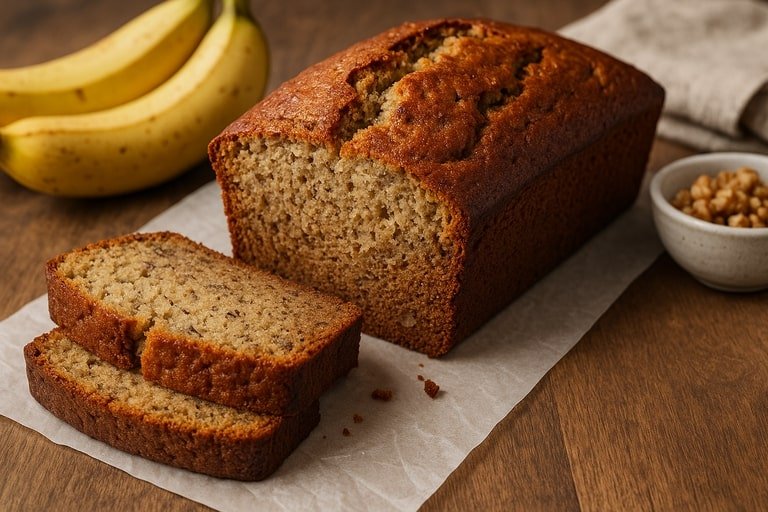
The best banana bread recipe is far more than a list of ingredients; it is the result of understanding ripeness, texture, balance, and the way heat transforms simple fruit into aromatic comfort. Ripe bananas, speckled with dark spots, hold concentrated sweetness and a softness that integrates seamlessly into batter. Their natural sugars caramelize during baking, filling the kitchen with fragrance. A recipe that uses underripe fruit lacks depth, while overripe bananas collapse into excessive mush. Knowing the right moment to use fruit separates casual baking from mastery, giving the loaf its signature richness and tenderness.
Flour choice influences texture as much as fruit. All-purpose flour remains standard, but careful bakers sometimes blend it with whole wheat for nuttiness or cake flour for delicacy. Gluten development requires attention—overmixing toughens crumb, undermining softness. Folding gently preserves air pockets and ensures a moist banana bread, while precision in measuring flour prevents density. The best banana bread recipe balances sturdiness with tenderness, creating slices that hold together without feeling heavy. This equilibrium of structure and softness defines the loaf’s appeal.
Sugar enhances flavor and supports browning. White sugar provides sweetness and a clean finish, while brown sugar adds caramel undertones and moisture due to molasses content. Some bakers employ a mix, capitalizing on both qualities. Others reduce sugar, relying on bananas’ natural sweetness, though balance is essential. Too little leaves blandness, while excess overwhelms nuance. Adjustments must also consider add-ins—chocolate chips, nuts, or spices—that alter overall sweetness perception. Mastery lies in tailoring sugar levels to context, producing complexity rather than monotony.
Fat content determines richness and mouthfeel. Butter delivers flavor and a golden crust, while oil provides lasting moisture and softness. A blend combines advantages of both, ensuring moistness without sacrificing taste. The method of incorporating fat matters—creaming butter with sugar introduces air, while whisking oil with eggs binds smoothly. Each choice influences crumb structure and keeping quality. A banana loaf made with oil often stays tender longer, while butter versions shine with immediate flavor impact. Decisions here define outcome as much as any spice or topping.
Eggs bind and enrich, but balance is delicate. Too many stiffen crumb; too few cause fragility. Eggs must be incorporated at proper temperature to emulsify effectively, creating uniform batter. Their proteins coagulate in the oven, setting structure while trapping moisture. Combined with mashed bananas, they contribute to the moist banana bread quality that defines excellence. Precision in this stage reflects discipline, turning potential inconsistency into dependable craft.
Leavening agents—baking soda and baking powder—provide lift, but their chemical interactions with bananas’ acidity demand accuracy. Baking soda neutralizes acids, encouraging browning and lightness, while powder provides additional insurance for rise. Excess soda leaves bitterness and discoloration, while insufficiency causes density. Proper ratios, measured meticulously, create a loaf that domes gently and cuts cleanly. Baking science here reveals itself not as rigid rule but as partnership between chemistry and intuition, uniting ingredients into transformation.
Spices elevate flavor without stealing spotlight. Cinnamon, nutmeg, or cardamom enhance bananas’ natural warmth, while vanilla rounds edges. A careful hand is crucial, as dominance of spice undermines fruit’s character. The best banana bread recipe treats spices as accent, not focus, ensuring each bite resonates with banana while offering subtle complexity. This restraint embodies professional discipline, valuing clarity over clutter.
Texture and add-ins personalize banana bread without compromising foundation. Walnuts or pecans add crunch, chocolate chips indulgence, dried fruit chewiness. Yet these must serve balance. Overloading batter with additions creates uneven baking, pockets of heaviness, or collapsing structure. Thoughtful distribution, folding gently at the end, ensures integration. Add-ins then enhance rather than distract, making the loaf distinctive without compromising its integrity.
Baking technique determines success. An oven preheated to steady temperature provides consistency, while middle rack placement ensures even cooking. Tentative bakers often overbake, fearing rawness, but dryness sacrifices essence. A skewer emerging with moist crumbs—not wet batter—signals readiness. Cooling is equally vital, as structure sets gradually. Cutting too soon squashes texture, releasing steam and leaving gummy centers. Respect for timing proves that patience rivals ingredients in defining excellence.
Homemade baking empowers adaptation, allowing cooks to experiment with flour blends, fat choices, or flavor infusions. Greek yogurt or sour cream adds tang and tenderness, espresso deepens chocolate variations, and honey or maple syrup introduces natural sweetness. Each adjustment honors tradition while refreshing relevance. This adaptability explains banana bread’s universal appeal—it welcomes variation without losing essence. The best banana bread recipe is therefore not one fixed formula but a foundation for exploration rooted in respect for fundamentals.
Ultimately, what distinguishes the best banana bread recipe is its balance: ripe fruit providing flavor, flour offering structure, sugar and fat harmonizing richness, leavening ensuring lift, spices adding depth. Together, these choices craft not merely food but an experience of comfort, aroma, and satisfaction. Banana bread endures because it embodies both simplicity and sophistication, rewarding attentiveness while forgiving imperfection. In every slice lies warmth, memory, and mastery—proof that even the humblest ingredients, treated with care, can achieve greatness.
Best banana bread recipe and the Art of Homemade Baking
Banana bread recipes hold enduring appeal because they unite practicality with indulgence. They transform surplus fruit into sustenance, turning waste into pleasure. For generations, cooks have relied on banana bread recipes as reliable ways to repurpose ripening fruit, preserving value and reducing waste. This resourcefulness contributes to its cultural status as much as its taste. Yet beyond pragmatism lies artistry, as bakers learn that ingredient ratios and technique define outcome. Each banana bread recipe is an opportunity to refine skill, exploring how minor adjustments create new dimensions of texture and flavor.
Bananas anchor these recipes with unique qualities. Their natural sugars caramelize, their starches convert, and their pectin influences structure. Ripe bananas, speckled with black spots, embody peak readiness, offering softness and concentrated flavor. Recipes relying on underripe fruit lack sweetness and texture, while overripe bananas risk excess moisture. Selecting fruit at its prime is therefore essential, determining whether banana bread emerges dense and bland or fragrant and moist. Bakers who master timing elevate their recipes from adequate to exceptional.
Flour and mixing technique shape crumb. Banana bread recipes emphasize gentle folding rather than vigorous stirring, preserving tenderness by avoiding overdeveloped gluten. This respect for structure distinguishes homemade baking from commercial production, where speed often trumps finesse. Measuring flour carefully, sometimes even by weight, ensures consistency. Too much flour yields heaviness, while too little prevents stability. The precision here reflects professional care, proving that banana bread succeeds when treated as craft rather than convenience.
Sugar adjustments within banana bread recipes reveal both preference and innovation. White sugar delivers brightness, while brown sugar deepens flavor with molasses undertones. Honey or maple syrup introduces natural complexity, though these alter moisture and require balancing. Bakers often experiment, discovering that sugar not only sweetens but also browns, moistens, and stabilizes. Banana bread becomes versatile because sugar choices allow infinite variation while retaining core identity. Each loaf reflects both science and personality, balancing chemistry with taste.
Fat choices carry equal influence. Butter imparts flavor and aroma, oil ensures lasting moistness, and dairy additions such as yogurt enhance tenderness. Banana bread recipes adapt to context, prioritizing flavor intensity or shelf life as desired. Some combine fats to achieve synergy, creating loaves that balance immediate satisfaction with durability. This adaptability illustrates the recipe’s resilience, proving that banana bread accommodates variation while preserving essence.
Eggs bind ingredients and add richness, their proteins coagulating during baking to provide structure. Leavening agents expand crumb, but precision is vital. Baking soda neutralizes acidity from bananas, encouraging browning, while baking powder supplies additional lift. Missteps create flatness or bitterness, while accurate ratios ensure rise and balance. In banana bread recipes, science and craft intersect visibly, as chemistry translates directly into sensory experience.
Spices, while optional, often define personality. Cinnamon or nutmeg enhances banana’s warmth, while vanilla contributes roundness. Some bakers embrace restraint, preferring fruit’s clarity, while others build complexity through layering. The key remains balance, avoiding dominance that obscures banana’s essence. This discretion illustrates maturity in baking, reflecting understanding that restraint often produces greater depth than excess.
Add-ins extend creativity. Walnuts, pecans, or chocolate chips diversify texture and flavor, though successful banana bread recipes integrate these thoughtfully. Overloading creates uneven baking and compromised crumb. Folding additions gently at the end preserves structure while distributing evenly. This balance ensures enhancement without distraction, allowing each bite to carry identity and variety simultaneously. The lesson is that creativity flourishes within limits, ensuring harmony rather than chaos.
Baking technique underpins all success. Preheating ensures even rise, while correct pan size influences texture. Banana bread bakes best at moderate heat, allowing interior to cook while exterior browns gradually. Testing with a skewer avoids underbaked centers, while patience during cooling prevents collapse. Recipes emphasize discipline as much as ingredients, teaching bakers that attentiveness converts potential into achievement.
Cultural resonance strengthens banana bread’s place in homemade baking. It symbolizes comfort during uncertainty, a reliable presence in kitchens across generations. Families pass down recipes, communities share loaves, and individuals adapt traditions. Its accessibility reinforces universality, reminding us that culinary excellence emerges not from rarity but from care. Banana bread recipes endure because they connect past and present, heritage and adaptation.
In essence, banana bread recipes illustrate the intersection of resourcefulness, science, and artistry. They transform humble ingredients into expressions of skill and comfort, offering both nourishment and delight. Their enduring popularity proves that tradition and innovation coexist harmoniously, sustaining relevance across time. Each loaf becomes narrative as much as sustenance, affirming that homemade baking carries significance beyond flavor. Banana bread recipes, in their simplicity and adaptability, exemplify why food continues to unite, comfort, and inspire.
Easy Banana Bread Recipe Secrets for Perfect Texture
An easy banana bread recipe appeals because it promises accessibility without sacrificing quality. Simplicity here does not mean mediocrity; it represents efficiency rooted in respect for fundamentals. The process hinges on ripe bananas, accurate measurements, and disciplined technique. Even in streamlined form, banana bread demands care. Skipping steps or neglecting balance leads to dense, flavorless loaves, while attentiveness ensures results that rival more elaborate methods. Ease arises from confidence and clarity, not shortcuts.
Ripe bananas remain centerpiece, their sugars and softness defining flavor and moisture. In easy banana bread recipes, mashing them thoroughly integrates evenly, preventing pockets of fruit that disrupt texture. Selecting bananas at optimal ripeness—speckled, soft, fragrant—delivers sweetness and ensures batter cohesion. Using underripe fruit compromises flavor, proving that even in simplicity, ingredient quality determines outcome.
Mixing method emphasizes restraint. Easy recipes highlight “mix until combined,” guarding against gluten overdevelopment. Dry and wet ingredients meet briefly, just long enough to unify without losing tenderness. Overmixing toughens crumb, while undermixing leaves streaks. This balance requires focus but not complication, embodying the principle that simplicity thrives when discipline replaces excess. Banana bread here demonstrates that less intervention can produce more satisfying results.
Fat choices streamline process without compromising flavor. Oil integrates quickly, avoiding creaming stages required by butter, making preparation straightforward. Yet flavor may be enhanced with melted butter for depth, blending efficiency with richness. Easy banana bread recipes exploit these trade-offs, selecting approaches that minimize effort while maximizing outcome. The principle remains constant: moisture and tenderness define success.
Leavening, though technical, remains simple when understood. Baking soda suffices for banana acidity, while a pinch of powder supports consistency. Proper ratios prevent collapse or bitterness, ensuring rise with minimal complication. This demonstrates how science supports simplicity, allowing even novice bakers to achieve dependable results through careful proportion. Easy banana bread recipes succeed because they respect these fundamentals, proving that clarity empowers confidence.
Sugar balances sweetness and structure. Straightforward recipes often favor brown sugar, combining flavor and moisture in one step. Others mix white and brown for nuance. The guiding principle is moderation, ensuring flavor without excess. Even in simplicity, sugar decisions shape crust, crumb, and balance, proving that easy does not equate to careless.
Spices and flavorings streamline enhancement. A teaspoon of cinnamon or splash of vanilla transforms banana bread without complicating process. These additions, though minimal, elevate character and create dimension. Easy banana bread recipes rely on such efficient interventions, demonstrating how subtlety achieves impact without increasing effort.
Add-ins, while optional, broaden possibilities. Chocolate chips, nuts, or fruit may be folded quickly at the end, customizing without undermining simplicity. Their integration demonstrates flexibility, proving that easy banana bread recipes accommodate individuality while preserving essence. Moderation again is key, ensuring additions complement rather than overwhelm.
Baking remains the critical stage, even in easy recipes. Moderate oven heat ensures even cooking, while skewer testing confirms readiness. Allowing bread to cool before slicing maintains texture, proving patience enhances outcome even when preparation is streamlined. The lesson is clear: ease arises not from rushing but from eliminating unnecessary complication.
Cultural significance underscores appeal. Easy banana bread recipes often serve as introductions to baking, accessible to novices yet satisfying for experts. Their reliability fosters confidence, creating successes that encourage further exploration. Families share simple formulas, ensuring continuity of tradition while adapting to changing times. In this way, easy banana bread represents not only efficiency but inclusivity.
Ultimately, the secret of an easy banana bread recipe lies in respect for essentials. Quality bananas, precise measurement, gentle mixing, balanced leavening, and patient baking converge to create loaves that satisfy without complication. Simplicity reveals itself as strength, not weakness, proving that mastery lies in clarity. These recipes endure because they balance accessibility with excellence, making banana bread a universal comfort available to all who bake with care.
Few baked goods evoke the same warmth and comfort as a freshly baked loaf of banana bread. Over generations, families have passed down their favorite formulas, each claiming to hold the best banana bread recipe. This enduring popularity is no accident: banana bread is a perfect example of how simplicity and flavor can come together in harmony.
It transforms overripe fruit into a golden loaf that fills the kitchen with inviting aromas and creates memories as sweet as its taste. Yet in the modern age, the challenge is not simply to replicate tradition but to refine it, adapting methods to suit contemporary palates while retaining the charm that made this bread a classic in the first place.
The foundation of the best banana bread recipe lies in its ingredients. Bananas serve as the heart of the loaf, offering moisture, natural sweetness, and a velvety texture. The balance between ripe bananas and complementary elements such as butter, flour, and eggs is what determines whether the bread becomes dense or fluffy.
Sugar adds depth, but it is the fruit that delivers character. Subtle notes of vanilla or cinnamon round out the flavor, creating a loaf that is both indulgent and approachable. For many, the thrill is not in complex techniques but in watching familiar pantry items transform into something extraordinary.
One of the defining qualities of banana bread is its adaptability. While the best banana bread recipe may call for classic staples, bakers around the world have introduced variations that reflect local tastes and dietary preferences. Some add chocolate chips for a decadent twist, while others fold in walnuts or pecans to create texture and earthy undertones. Health-conscious versions substitute whole wheat flour, honey, or plant-based fats, offering nourishment alongside flavor. This flexibility is part of the reason banana bread continues to thrive across generations and cultures, cementing its reputation as a timeless favorite.
Texture plays a crucial role in determining excellence. A loaf should strike a balance: moist without being soggy, light but not crumbly, and sturdy enough to slice yet tender on the tongue. Achieving this requires attention to detail during mixing. Overworking the batter can lead to toughness, while under-mixing leaves uneven pockets of flour. The best banana bread recipe emphasizes a gentle approach, folding ingredients carefully to preserve airiness and ensure even distribution. Mastering these small techniques elevates banana bread from ordinary to unforgettable.
Cultural significance also contributes to banana bread’s stature. Born in the early 20th century as households sought ways to avoid wasting overripe fruit, the bread quickly found its place in American kitchens and beyond. During economic downturns, it symbolized resourcefulness; during wartime, it embodied comfort. Today, it is no longer just a thrifty solution but a beloved tradition that unites bakers across the globe. The best banana bread recipe is not simply about flavor — it represents resilience, creativity, and the joy of turning something humble into something extraordinary.
The digital era has amplified banana bread’s popularity even further. Social media platforms brim with photos of golden loaves, shared by professional chefs and novice bakers alike. Viral challenges during global lockdowns made the bread a symbol of comfort and connection at a time of isolation.
Search engines recorded surges in queries for the best banana bread recipe, proof that even in uncertain times, people turn to simple, satisfying baking rituals. This widespread visibility ensures that banana bread remains not only relevant but also iconic in the ever-changing landscape of culinary trends.
Nutritional awareness has also reshaped perceptions. Modern bakers experiment with reducing sugar, incorporating gluten-free flours, or swapping butter for coconut oil to align with wellness-focused lifestyles. These variations demonstrate that the best banana bread recipe is not static but adaptable, capable of evolving alongside consumer values. By accommodating dietary needs without sacrificing taste, banana bread continues to invite everyone to the table, proving that inclusivity in food can be delicious and satisfying.
Global interpretations further highlight its versatility. In tropical climates, bakers may enhance the bread with coconut, mango, or spices like cardamom. In colder regions, hearty grains or dried fruits add warmth and sustenance. Each cultural spin reaffirms that the best banana bread recipe is a concept rather than a single formula, one that welcomes experimentation while holding onto the comforting essence of ripe bananas and tender crumb. This worldwide embrace underscores banana bread’s universal appeal as a dish that transcends borders and generations.
From an emotional perspective, banana bread carries meaning beyond its taste. It is a food of generosity, often baked to be shared with neighbors, gifted to friends, or served as a centerpiece at family gatherings. The act of baking itself becomes therapeutic, grounding the baker in a process that is both creative and rewarding. The best banana bread recipe embodies these connections, reminding us that food is not only about flavor but also about relationships, hospitality, and shared joy.
Professional chefs continue to elevate banana bread, offering gourmet interpretations that showcase technique without abandoning comfort. Some incorporate browned butter for nutty complexity, while others add a swirl of cream cheese filling or a crumble topping. High-end bakeries present banana bread in elegant slices, yet its essence remains approachable. Whether served in a café or baked in a humble kitchen, the bread maintains its ability to bridge sophistication and simplicity, a rare quality that ensures its lasting place in culinary culture.
Looking forward, the best banana bread recipe will continue to evolve alongside technology, tastes, and global influences. Smart appliances allow precise control over baking, ensuring perfect results every time. Recipe-sharing platforms foster creativity and community, encouraging bakers to swap techniques and inspire one another. As food culture embraces sustainability, banana bread will likely gain even more prominence as a delicious way to reduce waste while indulging in comfort. This adaptability guarantees its role as both a heritage dish and a modern staple.
In the end, banana bread’s magic lies in its dual identity: familiar yet endlessly reinvented, humble yet celebrated, simple yet capable of complexity. The best banana bread recipe is not a single document but a living tradition, shaped by countless hands and hearts over time. Each loaf tells a story of resourcefulness, creativity, and love. As long as there are bananas ripening on countertops and bakers eager to transform them, banana bread will remain a golden emblem of comfort, connection, and culinary joy.