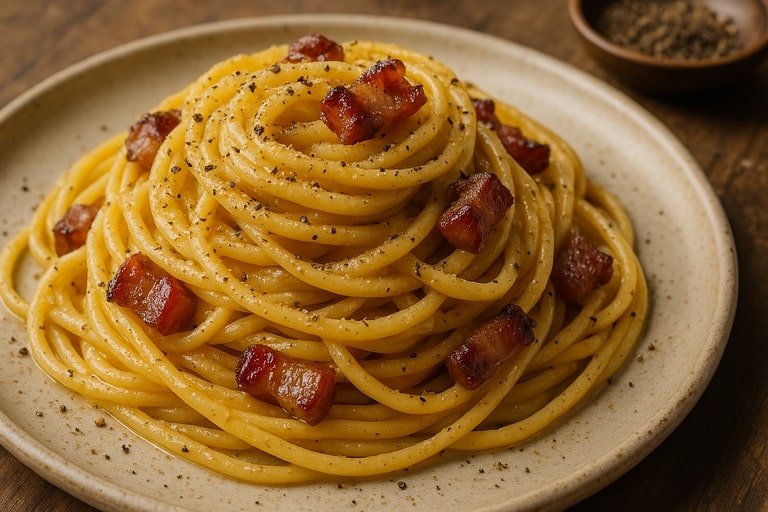
The spaghetti carbonara recipe carries a reputation that extends far beyond its Roman origins, standing today as one of the world’s most beloved pasta dishes. Unlike many interpretations that dilute its heritage with unnecessary additions, the true essence of carbonara rests in a few carefully selected ingredients combined with precision and restraint. At its foundation lies pasta, guanciale, eggs, Pecorino Romano, and black pepper, each contributing to a balanced whole greater than its parts. The magic of this dish is its simplicity paired with the need for flawless execution, which is why learning the technique is as vital as the ingredient list itself.
History enriches every plate of spaghetti carbonara. Scholars trace its popularity to mid-twentieth-century Rome, though its precise origins remain debated. Some link it to coal miners, whose work in the Apennine mountains earned them the nickname “carbonari,” while others suggest it rose during the post-war years, influenced by the availability of eggs and bacon from American rations. Regardless of its precise birth, carbonara quickly became embedded in Roman culinary tradition, cherished for its hearty yet refined character.
Central to the spaghetti carbonara recipe is guanciale, the cured pork jowl whose flavor surpasses that of pancetta or bacon. Its fat renders slowly, coating the pasta with richness while crisping into savory morsels. Replacing guanciale alters the authenticity of the dish, though many international adaptations employ pancetta for accessibility. Still, purists recognize guanciale as the key to unlocking the original Roman taste, where the balance of salt, fat, and depth sets carbonara apart from imitations.
Eggs form the creamy backbone of carbonara, yet their handling requires skill. Rather than forming scrambled curds, they must emulsify with hot pasta water and rendered fat to create a velvety sauce. Achieving this depends on timing: pasta must be drained at the moment of al dente perfection, then quickly tossed with beaten eggs and cheese off direct heat, relying on residual warmth to thicken without scrambling. It is this delicate transition, from liquid to silk, that distinguishes a true carbonara from a clumsy attempt.
Cheese is equally significant in a spaghetti carbonara recipe, with Pecorino Romano occupying a non-negotiable place. Its sharp, salty bite counterbalances the richness of egg and pork, ensuring no element overwhelms the palate. Some variations introduce Parmigiano-Reggiano, either in part or entirely, but this shifts the profile toward nuttier, milder tones. While still delicious, purists argue that Pecorino alone captures the robust Roman character intended by tradition.
Black pepper, cracked freshly, defines the seasoning of carbonara. Far from an afterthought, pepper interacts with the sauce, lending sharpness and aroma that cuts through richness. In Roman trattorias, generous grinding of pepper tableside often completes the dish, emphasizing its role as a central ingredient rather than a garnish. The balance of salt from cheese and guanciale with the spice of pepper exemplifies the dish’s elegance: bold, simple, and complete without additions.
The pasta itself demands equal attention in the spaghetti carbonara recipe. While spaghetti remains the most iconic choice, rigatoni or bucatini also find traditional acceptance. The pasta must be cooked to al dente firmness, its starch contributing subtly to the sauce’s texture when combined with reserved cooking water. Using overly soft pasta not only undermines mouthfeel but also hampers the ability to bind sauce effectively. Thus, mastery begins with something as basic yet essential as properly boiled noodles.
Common misconceptions have obscured the authenticity of carbonara, particularly the addition of cream. While cream can stabilize texture for the inexperienced cook, it undermines the purity of the dish by masking the natural emulsification of egg, cheese, and fat. Similarly, the inclusion of garlic, onions, or peas, though tasty in their own right, belongs to fusion adaptations rather than traditional recipes. Appreciating true carbonara requires respect for restraint, an understanding that its richness and depth derive from precision rather than abundance.
The cultural resonance of the spaghetti carbonara recipe extends into Italian identity itself. In Rome, ordering carbonara is more than a meal—it is an embrace of culinary heritage. Chefs debate details such as the exact ratio of cheese to egg yolks, yet all agree that authenticity requires confidence in simplicity. Visitors often leave surprised at how few components deliver such a memorable result, a testament to Italian philosophy where less becomes more through mastery.
Modern kitchens have expanded the carbonara conversation, experimenting with vegetarian versions that replace guanciale with mushrooms or smoked vegetables. While these adaptations cannot claim authenticity, they highlight the versatility of the carbonara method, proving that the technique of emulsifying eggs with pasta and cheese inspires creative reinterpretations worldwide. Still, returning to the original teaches lessons in discipline and balance that transcend trends.
To perfect the spaghetti carbonara recipe, one must not only follow steps but develop intuition. The sight of glossy pasta, the aroma of rendered guanciale, the sound of pepper crackling in a mortar—all these sensory cues guide the cook more effectively than rigid instructions. With practice, the dish becomes less about fear of curdling and more about confidence in timing, a rite of passage for those who seek to honor one of Italy’s most iconic creations.
Spaghetti carbonara recipes through cultural interpretation
Spaghetti carbonara recipes illustrate how tradition and adaptation interact across cultures. In Rome, the dish adheres to its strict form, but abroad, cooks often reinterpret it with local ingredients or preferences. This duality fuels debate: should authenticity be preserved at all costs, or can culinary evolution enrich the legacy? To explore this question, one must understand both the essence of traditional recipes and the motivations behind global adaptations.
In Italian kitchens, carbonara is less a recipe than a philosophy. The emphasis falls on respect for quality ingredients and precise technique, ensuring every element retains its integrity. Eggs are free-range, guanciale is artisanal, and Pecorino Romano comes from Lazio. For Italians, these details are not optional but intrinsic to authenticity, transforming the dish into a cultural artifact as much as a meal. Any departure risks severing the link to heritage.
Internationally, however, spaghetti carbonara recipes have become a canvas for creativity. In America, cream is frequently added to guarantee a rich sauce, catering to diners who prefer consistency over tradition. In Japan, carbonara often features cream and even mayonnaise, aligning with local tastes while retaining echoes of the original. These adaptations reveal how culinary traditions adapt to context, not to erase roots but to integrate with new cultural landscapes.
Yet debates persist around what constitutes authenticity. Critics argue that stripping away cream or garlic is pedantry, while defenders insist that respect for original form preserves identity. The tension lies not in taste alone but in symbolism: carbonara represents Roman resilience, a dish born of simplicity and scarcity, elevated through technique rather than embellishment. Preserving it means honoring this story.
The spread of spaghetti carbonara recipes also reflects globalization’s influence on food culture. As chefs travel, share techniques, and reinterpret classics, dishes acquire hybrid forms that appeal to diverse palates. While some lament the loss of tradition, others celebrate the exchange as a testament to food’s universal language. Carbonara thus becomes not only an Italian treasure but also a global participant in culinary dialogue.
The role of technique cannot be understated, regardless of interpretation. Whether in Rome or Tokyo, emulsifying eggs into a smooth sauce requires control of heat and timing. This universality ensures that even adaptations must reckon with the fundamentals, reminding cooks that innovation rests upon mastering tradition first. Skipping this step results in clumsy imitations rather than meaningful reinterpretations.
Authenticity in spaghetti carbonara recipes also raises questions of identity. For Italians, fidelity to tradition signifies pride in heritage, while for global cooks, adaptation reflects creativity and accessibility. Neither position is invalid, but clarity matters: calling a cream-based version “authentic” carbonara misrepresents history, while acknowledging it as an adaptation honors both original and reinterpretation.
Cultural context shapes preferences for protein as well. While guanciale remains non-negotiable in Rome, many households elsewhere rely on pancetta or bacon. Though these alternatives lack the depth of cured jowl, they remain practical for regions where guanciale is scarce. Here, adaptation arises from necessity, echoing carbonara’s origins as a resourceful dish crafted from available ingredients.
The popularity of spaghetti carbonara recipes has also influenced fine dining, where chefs deconstruct the dish, serving yolk emulsions alongside crisped guanciale shards in modernist presentations. While controversial, such reinterpretations testify to carbonara’s status as a cultural icon worthy of artistic exploration. That chefs reimagine it at the highest levels proves its enduring power.
Ultimately, the debate between tradition and adaptation enriches rather than diminishes carbonara’s story. Each recipe, whether authentic or reinterpreted, reflects the cook’s context and values. By engaging with both perspectives, one appreciates carbonara not as a static formula but as a living tradition, simultaneously rooted in Rome and evolving across the globe.
Spaghetti carbonara recipe and how to make spaghetti carbonara
When considering a spaghetti carbonara recipe in the context of how to make spaghetti carbonara, clarity of technique becomes paramount. Many cooks fear the moment of combining eggs with hot pasta, yet understanding the science behind the process transforms anxiety into confidence. Success lies not in chance but in preparation, timing, and trust in the principles that generations of Italians have refined.
The first step in making spaghetti carbonara is preparing ingredients with precision. Guanciale should be cut into lardons of even size, ensuring consistent rendering of fat and crispness. Pecorino Romano must be grated finely so it integrates smoothly into the sauce. Eggs should be beaten thoroughly, often yolks emphasized for richness, though whole eggs are also common. This groundwork ensures that when the critical moment arrives, no detail undermines the process.
Cooking pasta al dente is the foundation of how to make spaghetti carbonara. Proper salting of water enhances flavor, while timing ensures firmness and elasticity. Overcooked pasta absorbs sauce poorly, turning creamy carbonara into a heavy, cloying dish. Precision here signals respect for tradition and for the diner, setting the stage for harmony.
As guanciale renders, its fat becomes liquid gold, both crisping the pork and providing the base for the sauce. Removing it at the right moment, before burning yet after achieving deep flavor, requires attentiveness. This rendered fat combines with hot pasta to form the canvas upon which eggs and cheese build their emulsion. Misjudging this step risks either greasiness or blandness, underscoring the importance of observation.
The critical technique of how to make spaghetti carbonara involves tossing pasta with eggs and cheese off direct heat. This prevents scrambling while allowing residual warmth to thicken the sauce gradually. Cooks often reserve a small amount of pasta water, adding it slowly to adjust consistency. Mastery emerges not from rushing but from patience, watching as sauce transforms into a glossy coating that clings to every strand.
Pepper, freshly ground, enters at the final stage, releasing volatile oils that infuse aroma and spice. Its timing ensures that flavor remains bright rather than muted by prolonged heat. In this step, one sees the elegance of carbonara: a dish that elevates everyday ingredients through thoughtful sequencing rather than complexity.
Learning how to make spaghetti carbonara also involves understanding common errors. Excess heat scrambles eggs, insufficient mixing yields clumps, and lack of seasoning leaves the dish flat. Yet each mistake becomes an opportunity to refine technique. With practice, cooks internalize the sensory cues—sight of sheen, smell of guanciale, sound of pepper cracking—that signal success.
Beyond technique, making carbonara teaches lessons in restraint. The temptation to add cream, garlic, or vegetables reflects a misunderstanding of its philosophy. True mastery comes from confidence in simplicity, an embrace of quality ingredients handled well. This lesson transcends cuisine, reminding cooks that the highest achievements often arise from focus rather than embellishment.
Serving carbonara immediately is essential, as its creamy texture is fleeting. Left to sit, the sauce congeals, losing its allure. Italians understand that carbonara demands presence: it must be eaten hot, at the moment of perfection, shared among those who appreciate its fleeting beauty. This immediacy reinforces its status as both comfort and craft.
Teaching others how to make spaghetti carbonara reinforces its value as a culinary rite. Passing the knowledge from one cook to another ensures continuity of tradition while inviting reinterpretation. The dish thus becomes not only nourishment but also education, a reminder of the bond between technique and culture.
In mastering spaghetti carbonara, one realizes that the recipe is both simple and profound. It requires no exotic ingredients or elaborate steps, yet it demands attentiveness, precision, and respect for tradition. By understanding how to make spaghetti carbonara, cooks connect with a lineage of artisans who have transformed humble components into one of Italy’s most enduring gifts to the culinary world.
Few dishes carry as much culinary heritage and global recognition as spaghetti carbonara. Beloved for its creamy sauce, salty cured pork, and delicate balance of flavors, it represents the very essence of Italian comfort food. The enduring appeal of spaghetti carbonara lies in its simplicity — just a handful of ingredients, yet extraordinary depth. Originating in Rome and spreading across the world, it has become both a symbol of authenticity and a dish open to reinvention, making it one of the most celebrated recipes in Italian cuisine.
The roots of spaghetti carbonara are closely tied to Roman tradition. Though its precise origins are debated, most agree it emerged in the mid-20th century. One theory connects it to coal miners (“carbonari”), who prepared pasta with cured pork and eggs for sustenance. Another points to American soldiers in Italy during World War II, introducing bacon and eggs to local cooking traditions. Whatever its history, the dish quickly became a staple of Roman kitchens, and the authentic spaghetti carbonara remains one of Italy’s proudest culinary exports.
At its heart, the dish relies on a few essential ingredients: pasta, guanciale, eggs, Pecorino Romano cheese, and black pepper. Each element contributes a vital role. Guanciale, cured pork jowl, provides richness and depth, its rendered fat coating the pasta with flavor. Pecorino Romano adds sharpness and saltiness, balancing the eggs’ creaminess. Black pepper introduces heat and complexity, cutting through the richness. The brilliance of spaghetti carbonara lies in how these simple ingredients harmonize without need for cream, butter, or garlic.
The technique defines the dish as much as the ingredients. Cooked spaghetti is tossed with hot guanciale and its rendered fat, then combined with a sauce made from beaten eggs and cheese. The key is timing: if the pasta is too hot, the eggs scramble; too cool, and the sauce fails to emulsify. The result, when done correctly, is a silky, creamy coating that clings to every strand. Spaghetti carbonara exemplifies how mastery of technique can elevate even the humblest pantry staples.
Texture is central to its success. Perfectly al dente pasta provides the backbone, giving bite and structure. The sauce must be velvety, not clumpy, coating the noodles evenly. Crispy bits of guanciale contrast with the creaminess, creating balance in every bite. The black pepper adds subtle grit and warmth. A successful plate of spaghetti carbonara delivers complexity of texture, reminding us that the interplay of crunch, creaminess, and chewiness creates satisfaction far greater than any single element.
Regional and cultural adaptations highlight the dish’s journey beyond Italy. In many parts of the world, pancetta or bacon replaces guanciale due to availability, while Parmesan substitutes for Pecorino. Some versions introduce cream or garlic, though purists argue these dilute the authenticity. Japanese kitchens have embraced spaghetti carbonara with local twists like miso or seafood, while American chefs often create fusion versions with mushrooms or chicken. Each interpretation shows how the dish has adapted globally while preserving its essence as pasta enriched with eggs, cheese, and cured pork.
Nutritional considerations have also influenced modern versions. While traditional spaghetti carbonara is undeniably rich, lighter adaptations incorporate whole-grain pasta, reduced pork, or additional vegetables like zucchini or peas. Plant-based versions replace eggs with vegan alternatives and use smoky seasonings in place of guanciale. These variations prove that the dish can align with contemporary dietary needs without losing its character. The adaptability of spaghetti carbonara ensures its continued relevance in diverse kitchens worldwide.
Restaurants showcase carbonara as both rustic and refined. Roman trattorias serve it in its purest form, emphasizing tradition and authenticity. Fine dining chefs elevate it with artisanal pasta, heritage pork, and aged cheeses, creating luxurious renditions that still honor the classic. Casual eateries adapt it into approachable weeknight meals, while food trucks experiment with playful spins. This range demonstrates that spaghetti carbonara is not only timeless but also versatile enough to thrive in every dining context.
The digital age has amplified its popularity even further. Food bloggers, YouTube chefs, and social media influencers share tutorials on mastering the technique, emphasizing details like heat control and pasta water emulsification. Viral posts highlight its glossy sauce and pepper-flecked surface, inspiring home cooks to recreate the dish. Online debates over authenticity — cream versus no cream, guanciale versus bacon — fuel its visibility and reinforce the importance of tradition. Spaghetti carbonara thrives in this space because it combines visual appeal with cultural significance.
Emotional connections further explain its timelessness. For many Italians, carbonara evokes memories of family gatherings and meals in local trattorias. For others, it recalls the excitement of discovering authentic Italian food abroad. The aroma of sizzling guanciale and the first bite of creamy pasta deliver comfort, nostalgia, and joy. Food is never just about flavor — it is also about memory and belonging. The enduring love for spaghetti carbonara comes from the way it satisfies both appetite and sentiment.
Practicality ensures its enduring place in home kitchens. With just a few ingredients and less than 30 minutes, anyone can prepare a satisfying meal. It requires no elaborate equipment or expensive components, making it accessible to households worldwide. Its forgiving nature allows beginners to attempt it, while its subtleties challenge advanced cooks to perfect it. The spaghetti carbonara recipe demonstrates that true culinary treasures are those that balance simplicity, accessibility, and depth.
Ultimately, spaghetti carbonara remains timeless because it embodies the very heart of Italian cooking: respect for ingredients, mastery of technique, and joy in simplicity. It connects past and present, tradition and innovation, authenticity and adaptation. Whether enjoyed in a Roman trattoria, a modern restaurant abroad, or a home kitchen, it delivers the same promise — warmth, satisfaction, and culinary elegance. Spaghetti carbonara is more than a dish; it is a cultural symbol, a comfort food, and an enduring reminder of how food can unite people across time and place.