The pot roast recipe stands as one of the most enduring staples of home cooking, a dish that blends hearty cuts of beef with vegetables and slow-simmered broth to produce comfort that transcends generations. More than simply meat and vegetables in a pot, pot roast embodies patience, tradition, and resourcefulness, turning inexpensive cuts into meals that nourish both body and spirit. Across cultures and centuries, variations of pot roast have offered sustenance, yet the dish retains a universal identity rooted in transformation and generosity.
The origins of pot roast trace back to European immigrants who brought braising techniques to America, where resourceful households adapted them to local ingredients. French boeuf à la mode and German sauerbraten influenced American cooking, while Dutch ovens provided vessels for slow simmering. By the nineteenth century, pot roast had become emblematic of Sunday dinners in American households, uniting families around tables and affirming cultural continuity through food.
At its core, the pot roast recipe emphasizes transformation through slow cooking. Cuts such as chuck, brisket, or round, often too tough for quick grilling or frying, soften when braised gently over hours. Collagen melts into gelatin, enriching broth naturally, while vegetables release sweetness that melds with meat. This transformation underscores a culinary truth: time itself is an ingredient, as vital as seasoning or technique.
Flavor layering distinguishes pot roast from simple boiled dinners. Initial searing caramelizes beef, creating Maillard reaction flavors that deepen broth. Deglazing with wine, stock, or beer captures browned bits, enriching sauce with complexity. Aromatics like garlic, thyme, and bay leaves infuse steadily, balancing richness with fragrance. These steps demonstrate that mastery lies not in abundance of ingredients but in attentiveness to process.
Culturally, pot roast symbolizes both economy and abundance. Historically, it stretched affordable cuts into meals that fed large families, reflecting resourcefulness. At the same time, its presence at Sunday dinners or holidays signified celebration, offering abundance through generosity. This dual role explains its enduring place in households, where it bridges everyday sustenance with special occasion.
The sensory qualities of pot roast amplify its appeal. The aroma of beef and vegetables simmering throughout the day transforms homes, signaling comfort long before mealtime. The visual satisfaction of tender meat falling apart and vibrant vegetables glistening in sauce reassures, while the warmth of a bowl anchors both body and memory. These sensory experiences embed pot roast into tradition.
From a nutritional perspective, pot roast balances indulgence with wholesomeness. Protein-rich beef pairs with fiber-packed vegetables, while broths enriched with herbs and aromatics add vitamins and minerals. Adjustments—leaner cuts, reduced fats, extra vegetables—align with modern dietary goals without diminishing essence, proving pot roast’s adaptability across generations.
Professional kitchens elevate the pot roast recipe by refining presentation and technique. Chefs may incorporate artisanal wines, heritage vegetables, or reduction sauces, transforming rustic roots into fine dining. Yet even in elegant contexts, pot roast retains identity as a dish of patience, depth, and generosity, affirming its dual role as comfort food and culinary artistry.
Practicality further underscores its cultural role. Large batches ensure leftovers, which often taste richer the next day as flavors continue to meld. This quality affirms pot roast as not only meal but investment, sustaining households across days while reinforcing comfort.
Ultimately, the pot roast recipe represents tradition, transformation, and care. In every simmering pot lies continuity between past and present, where resourcefulness and abundance coexist. More than instructions, it embodies cultural heritage, communal bonds, and culinary artistry that ensure its timeless presence.
Pot Roast and Recipe Mastery
Perfecting a pot roast recipe requires more than patience; it demands attentiveness to each stage of preparation, where searing, seasoning, and simmering converge into harmony. While the method appears simple, mastery lies in detail, transforming basic ingredients into extraordinary meals.
Ingredient selection begins with beef suited for braising. Chuck roast, brisket, or round provide marbling and connective tissue that break down into tenderness. Vegetables—carrots, onions, celery, potatoes—contribute sweetness and structure, while additions such as parsnips, mushrooms, or turnips expand depth. Mastery lies in balancing these elements, ensuring they complement rather than compete.
Searing meat forms the foundation of flavor. High heat caramelizes surface proteins, creating crusts that enrich broth through the Maillard reaction. Deglazing with wine, beer, or stock dissolves browned bits, capturing flavor that elevates final sauce. This initial step distinguishes average roasts from memorable ones, emphasizing technique over shortcuts.
Simmering governs transformation. Gentle heat over hours softens meat and integrates vegetables into cohesive dish. Too high a temperature toughens meat, while insufficient time leaves it chewy. Timing ensures balance: roots early for structure, delicate greens later for vibrancy. Mastery lies in synchronizing these elements into harmony.
Seasoning strategy defines depth. Aromatics like garlic, thyme, rosemary, and bay leaves release slowly, building complexity. Salt sharpens flavors, while acidity from tomatoes or vinegar balances richness. Final adjustments before serving—fresh herbs, a splash of wine, or citrus zest—brighten flavors, proving that mastery requires both patience and finishing finesse.
Texture refinement elevates pot roast further. Natural thickening from gelatin creates body, but flour, cornstarch, or pureed vegetables may enhance sauce. Stirring occasionally ensures even distribution and prevents sticking. Achieving balance between hearty thickness and fluid broth reflects another mark of mastery.
Modern adaptations reflect inclusivity. Plant-based versions with mushrooms or legumes replicate richness, while gluten-free thickeners or leaner cuts accommodate dietary needs. These adaptations affirm that pot roast’s identity lies in process and patience rather than rigid formula.
Professional mastery involves presentation as well. Serving pot roast in cast-iron vessels or garnished with herbs elevates rustic roots into artistry. Chefs understand that comfort food can embody elegance, proving mastery extends beyond flavor into experience.
Psychologically, preparing pot roast signals care. Its lengthy preparation represents investment in those who will share it, transforming process into ritual of generosity. This symbolism ensures pot roast remains emblem of familial love and continuity.
Mastery also involves understanding leftovers. Pot roast improves upon resting, as flavors deepen overnight. Chefs and home cooks alike embrace this quality, planning for meals that extend beyond the initial dinner. Mastery, then, includes foresight, ensuring continuity of comfort.
Ultimately, recipe mastery for pot roast reflects respect for tradition and attentiveness to process. By searing carefully, seasoning thoughtfully, and simmering patiently, cooks transform simple ingredients into culinary legacies. In every perfected pot roast lies testament to detail, patience, and care.
Pot Roast Recipe and Everyday Comfort
The pot roast recipe resonates most profoundly as everyday comfort food, embodying nourishment, ritual, and memory. Beyond its hearty flavors, it sustains cultural and emotional needs, offering reassurance in daily life and continuity across generations. Its timeless popularity lies in its ability to comfort through both flavor and tradition.
The aroma of pot roast simmering throughout the day defines comfort. Herbs, meat, and vegetables mingling in broth create fragrance that fills homes, providing reassurance long before dinner. This sensory presence transforms routine days into occasions of warmth.
In households, pot roast symbolizes family. Prepared in large pots, it sustains gatherings, embodying generosity and abundance. Its presence at Sunday dinners or holidays affirms continuity, anchoring families through ritual. Shared at tables, it comforts by reinforcing bonds of care.
Culturally, pot roast represents resilience. Born from resourcefulness, it transforms affordable cuts into sustenance that lasts. Its adaptability across climates and cuisines reflects universal values of thrift, patience, and generosity. Comfort arises not only from nourishment but from symbolic endurance.
The sensory aspects amplify comfort further. The tenderness of beef, the sweetness of carrots, the richness of broth—all combine to soothe body and spirit. Eating pot roast evokes childhood kitchens, family gatherings, or festive traditions, grounding comfort in memory.
Psychologically, pot roast reassures during uncertainty. Its familiarity provides continuity, recalling rituals that endure despite change. In this sense, comfort arises as much from emotional connection as from flavor.
Modern lifestyles adapt pot roast into varied contexts. Slow cookers, pressure cookers, and instant pots accelerate preparation without erasing tradition. Even simplified methods preserve essence, ensuring pot roast remains relevant in fast-paced societies.
Nutritionally, pot roast offers balance. Leaner cuts paired with vegetables and herbs create meals that are hearty yet wholesome. This alignment with wellness confirms pot roast’s dual role as indulgence and nourishment, aligning comfort with health.
Professional kitchens elevate pot roast into refined contexts, yet its identity as comfort food persists. Whether rustic or elegant, its essence lies in patience, abundance, and generosity. This duality affirms its timeless relevance.
Ultimately, the pot roast recipe embodies everyday comfort by uniting nourishment, ritual, and tradition. In every simmering pot lies affirmation of resilience and care. Its flavors comfort, its rituals reassure, and its presence sustains families and communities, ensuring pot roast remains timeless emblem of warmth.
Pot roast is one of those dishes that transcends time and trend, a classic that has comforted families for generations while never losing its relevance. At its essence, it is a meal of transformation, where simple, affordable ingredients become extraordinary through patience and care.
A pot roast recipe is not merely a set of instructions but a ritual that reflects values of warmth, resourcefulness, and connection. Every version carries echoes of history, whether served at a Sunday table, a holiday gathering, or on a quiet evening when something hearty and familiar is needed. It is both everyday sustenance and a celebration of tradition.
The origins of pot roast can be traced to European braising methods brought to America by immigrants, where tough cuts of beef were slowly cooked until tender. In Germany, sauerbraten represented a vinegar-marinated cousin, while in France, boeuf à la mode carried elegance and refinement.
When these traditions crossed the Atlantic, they adapted to new ingredients and circumstances, evolving into what Americans came to know as pot roast. It became a symbol of home cooking, a dish that could stretch resources, fill the house with rich aromas, and feed a family generously. Over time, the pot roast recipe was enshrined as a cornerstone of comfort food.
At the heart of the dish lies the cut of beef itself. Unlike quick-searing steaks, pot roast relies on tougher cuts like chuck, brisket, or round, which are rich in connective tissue. These cuts transform during slow cooking, breaking down into tender morsels that release deep flavor into the broth. The process reflects the wisdom of resourceful cooking: turning inexpensive cuts into meals that feel luxurious. Browning the meat before braising is essential, creating a crust that infuses the dish with richness and complexity. This step is more than technique; it is a ritual that signals the beginning of something remarkable.
Vegetables play an equally important role in a pot roast recipe. Carrots, onions, and potatoes are the classics, their earthy sweetness balancing the richness of the beef. Celery, parsnips, or turnips can be added for variation, while mushrooms contribute depth and umami.
As the roast simmers, these vegetables absorb the broth, becoming infused with the essence of meat and herbs. Their textures soften into tenderness, providing contrast to the melt-in-your-mouth beef. This marriage of meat and vegetables reflects the spirit of balance that defines traditional cooking — nothing extravagant, everything harmonious.
The broth is the soul of pot roast, binding everything together into a unified whole. Beef stock, wine, or even beer provide a flavorful base, while herbs like thyme, rosemary, and bay leaf add aromatic complexity. Garlic and tomato paste contribute depth, and as the liquid reduces over hours, it thickens into a sauce that coats every bite. This transformation illustrates the alchemy of braising, where patient simmering turns liquid and solids into one coherent, deeply flavored dish. It is here that the magic of pot roast resides, in the quiet evolution of broth into something luxurious.
Culturally, pot roast became emblematic of American family life in the twentieth century. It was the dish served on Sundays, when families gathered to share stories, rest, and prepare for the week ahead. It appeared at holidays, bringing nostalgia and unity to the table. For many, the memory of walking into a home filled with the aroma of a pot roast simmering in the oven remains one of the strongest connections to childhood. This cultural weight explains its persistence: pot roast is more than food, it is a reminder of belonging and tradition.
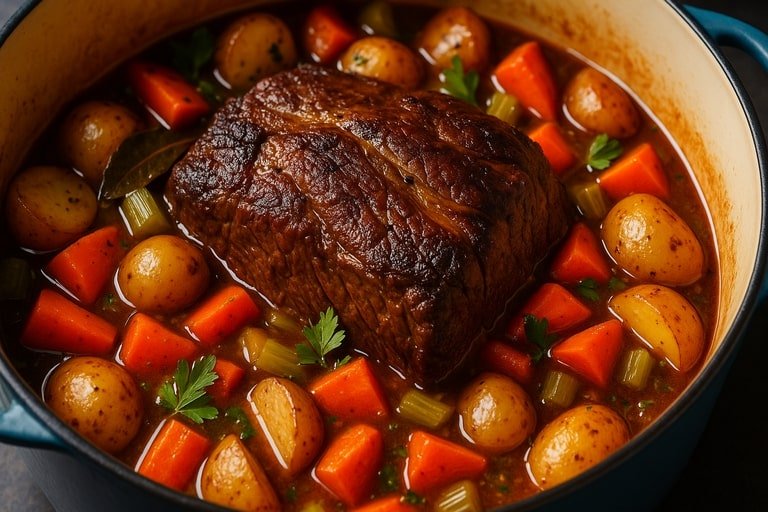
The sensory qualities of pot roast explain why it endures. The sight of a browned roast nestled among vegetables, steam rising from rich gravy, evokes anticipation before the first bite. The smell of herbs, garlic, and caramelized meat fills a room, wrapping everyone in comfort. The taste delivers depth and harmony, layers of flavor that feel both familiar and indulgent. The texture — beef so tender it falls apart with a fork, vegetables infused with broth — ensures satisfaction in every mouthful. Eating pot roast engages every sense, reminding us why simple dishes often carry the most power.
Economically, pot roast reflects practicality and sustainability. By using inexpensive cuts of meat and seasonal vegetables, families create meals that feel abundant without excess cost. Leftovers are easily repurposed into sandwiches, soups, or hash, stretching their value further. This efficiency is part of the dish’s identity: resourcefulness turned into richness. Pot roast demonstrates how thoughtful cooking can turn limited resources into abundance, affirming that good food is not about extravagance but about care, time, and creativity.
Modern variations continue to expand the tradition. Some recipes incorporate global flavors, adding soy sauce, miso, or curry spices to create fusion versions. Others experiment with slow cookers or pressure cookers, adapting the method for modern convenience without sacrificing depth. Chefs in fine dining settings reinterpret pot roast with premium cuts and artistic plating, proving that the dish can be both rustic and refined. Despite these innovations, the essence remains unchanged: meat, vegetables, and broth simmered patiently into harmony. Adaptability ensures that pot roast remains relevant across generations.
Psychologically, pot roast carries immense emotional resonance. Preparing it involves rituals — seasoning meat, browning, layering vegetables, waiting for the simmer — that ground the cook in rhythm and mindfulness. The anticipation builds throughout the day as aromas intensify, creating a sense of security and comfort. Sharing the finished dish multiplies this effect, reinforcing bonds between family members and friends. Even eaten alone, pot roast provides companionship through its richness and familiarity, reminding the diner of tradition and care.
Globally, pot roast connects with other braised traditions, proving its universality. From French daubes to Italian brasatos, from Chinese red-cooked beef to Latin American carne guisada, cultures across the world have their own variations of the same principle: transform tough cuts into tenderness through patience. The American pot roast belongs to this global family, reflecting how shared human needs — warmth, nourishment, and comfort — manifest in different but familiar ways. In every culture, the idea of a long-simmered dish ties people to heritage and resilience.
Ultimately, the pot roast recipe endures because it represents the essence of cooking itself: transformation, patience, and generosity. It turns ordinary ingredients into extraordinary meals, feeds not only the body but also the spirit, and brings people together across tables and generations. Its roots in tradition make it timeless, while its adaptability keeps it relevant. To prepare pot roast is to honor the wisdom of the past while creating comfort in the present, proving that the most enduring dishes are often the simplest. In every tender bite lies history, memory, and the quiet magic of food.
Few dishes carry the same weight of tradition and comfort as pot roast, a meal that feels both timeless and deeply personal. The beauty of a pot roast recipe lies not in complexity but in transformation: a humble cut of beef, inexpensive vegetables, and a patient cooking method evolve into something that feels luxurious and celebratory. For generations, families have gathered around tables where pot roast took center stage, its aroma filling homes with anticipation. It is a dish that transcends trends, remaining relevant across decades because it connects nourishment with memory and ritual.
The roots of pot roast stretch back to Europe, where braising was a central cooking technique for transforming tougher cuts of meat into tender feasts. French, German, and Dutch immigrants carried these traditions with them to America, adapting the method to local ingredients.
Over time, the dish became uniquely embedded in American family culture, especially in the nineteenth and twentieth centuries, when it was considered the quintessential Sunday dinner. The cultural symbolism of pot roast is therefore twofold: it is both a link to Old World techniques and a distinctly New World adaptation that became inseparable from the identity of home cooking.
At the core of the recipe is the beef itself, typically cuts such as chuck roast, brisket, or bottom round. These cuts are not prized for quick cooking but shine under low, slow heat, where connective tissues break down into gelatin, creating succulence and depth of flavor. Browning the meat is a step no cook should skip, as caramelization adds a foundation of richness that will permeate the dish. The process is both practical and symbolic — it signals the transformation to come, where simple beginnings will yield extraordinary results after hours of patient cooking.
Vegetables provide essential balance to the richness of the beef. Carrots, onions, and potatoes are staples, but variations may include parsnips, rutabagas, or celery root, each contributing subtle nuances. As the roast simmers, these vegetables absorb the essence of the broth, becoming infused with savory richness while offering contrasting sweetness and earthiness. Their tenderness by the end of the cooking process ensures harmony in every bite, proving that a successful pot roast is not just about the meat but about the interplay between all its components.
The broth or liquid base of a pot roast recipe is where the magic unfolds. Beef stock, red wine, beer, or even cider provide depth, while aromatics like garlic, thyme, bay leaves, and rosemary layer additional complexity. The liquid reduces gradually, thickening into a sauce that binds every element of the dish together. This sauce is the embodiment of transformation, proof of how time and patience can turn water and wine into velvety richness. For many, this gravy is the highlight, ladled generously over meat, vegetables, and sometimes even bread, extending the comfort beyond the main dish.
Culturally, pot roast has long been associated with family rituals. It is not a meal eaten in haste but one planned and awaited, its long cooking time filling the home with fragrance that builds anticipation. In many families, Sunday dinner was synonymous with pot roast, bringing relatives together for conversation, connection, and rest before the week began. These cultural associations are as integral to the recipe as the ingredients themselves, embedding it with nostalgia and emotional resonance that make it more than just food.
The sensory qualities of pot roast are unparalleled. The golden-brown crust of the meat, the jewel tones of carrots and potatoes, the deep mahogany of the sauce — together they create a visual feast. The aroma of herbs and caramelized onions signals comfort before the first bite. The taste is layered, combining the richness of beef with the sweetness of vegetables and the earthiness of herbs, while the texture of tender meat falling apart with a fork ensures every mouthful is deeply satisfying. This sensory symphony explains why pot roast endures even in an age of faster meals.
From a nutritional standpoint, pot roast provides balance when prepared thoughtfully. The beef offers protein and iron, while vegetables contribute fiber, vitamins, and minerals. Broth-based preparations can be surprisingly wholesome, especially when excessive fat is skimmed away. For those who desire lighter versions, leaner cuts of beef and an emphasis on root vegetables achieve the same comforting essence without excess richness. This adaptability proves that pot roast can meet contemporary wellness goals without losing its identity as a dish of abundance and warmth.
Economically, pot roast represents resourcefulness at its best. By using inexpensive cuts and seasonal vegetables, households historically created meals that felt abundant without strain. The generous portions meant leftovers, which could be reinvented as sandwiches, soups, or hashes, stretching value even further. In this way, pot roast reflects not only culinary tradition but also wisdom about making the most of resources. Its enduring popularity lies partly in this practicality: it is a dish that respects both appetite and economy, a rare balance in cooking.
Modern kitchens have embraced new technologies that simplify pot roast preparation without compromising results. Slow cookers replicate the long, gentle heat of an oven, allowing families to prepare meals before leaving for work and return to a dinner ready to serve. Pressure cookers condense the process into a fraction of the time, appealing to contemporary schedules. Chefs in fine dining establishments reimagine pot roast with global flavors, introducing soy, miso, or exotic spices while still honoring the essence of the dish. These innovations prove the resilience of the recipe, capable of adapting while staying true to its roots.
Psychologically, preparing pot roast provides a sense of stability and mindfulness. The process of searing, layering, and simmering offers rhythm and ritual, grounding the cook in care and patience. The aromas that fill the home create comfort before the dish is even eaten, reminding everyone present that something special is on its way. Sharing the meal reinforces connection, as pot roast is almost always cooked in quantities meant for more than one. In solitude, it provides reassurance, while in company, it fosters unity — proof that food can provide emotional nourishment as well as physical sustenance.
Ultimately, the pot roast recipe endures because it reflects values that never fade: patience, transformation, and generosity. It takes what is ordinary and elevates it into something extraordinary through time and care. It unites cultures through shared principles of braising and simmering, while also grounding families in traditions that evoke belonging and memory. To prepare pot roast is to participate in a lineage of cooks stretching back centuries, each seeking the same outcome: a meal that warms, sustains, and connects. In every forkful lies history, love, and the essence of what food is meant to be.